Jupiters Singing Voice
2 March 2026
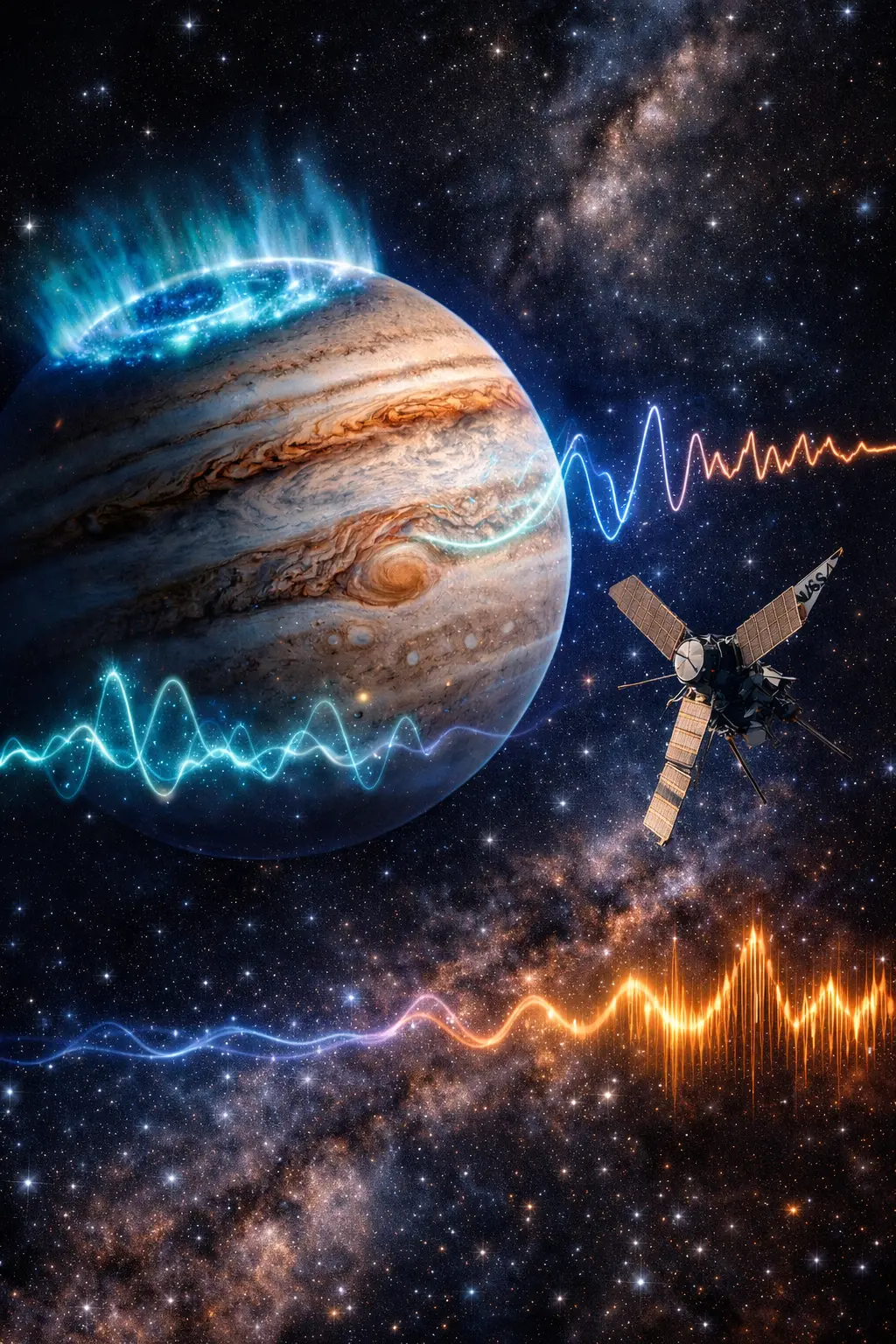
For centuries, humanity gazed at Jupiter as a silent giant wandering through the night sky. Yet this massive planet has been singing all along—a song composed not of melody, but of electromagnetic waves generated by its vast magnetosphere.
NASA’s Juno spacecraft, which entered orbit around Jupiter in 2016, captured these emissions and converted them into audible frequencies. What emerged was haunting: a chorus of chirps, whistles, and low-frequency roars that sound almost organic. The planet’s magnetic field, the strongest of any world in our solar system, accelerates charged particles from volcanic eruptions on its moon Io. These particles spiral along field lines, generating radio waves through a process called cyclotron maser instability.
The “voice” changes dramatically depending on where Juno listens. Near the poles, the emissions grow frenetic and high-pitched. At the equator, they deepen into something resembling distant thunder. Scientists have even detected subtle variations tied to Jupiter’s rotation—every 10 hours, the pattern shifts as if the planet itself breathes in rhythm with its day.
What makes this discovery profound is its universality. Similar emissions have been detected from Saturn, Earth, and even exoplanets. Jupiter’s singing voice may be the first we’ve truly heard, but it suggests that planets everywhere are broadcasting their presence through space, waiting for someone to tune in.